
Updated:
Quick answer: indirect lighting is light that is aimed at a surface, such as a ceiling, wall or piece of furniture, instead of at you. The surface reflects it and spreads it softly around the room. It is usually created with LED strips hidden in ceiling coves, mouldings or joinery, and works best with warm, dimmable light controlled by scenes.
If you are renovating a villa or apartment in Spain, indirect lighting is one of the simplest ways to make rooms feel larger and calmer. This guide explains what indirect lighting is, where to use it, what you need and how to control it.
Contents
What is indirect lighting?
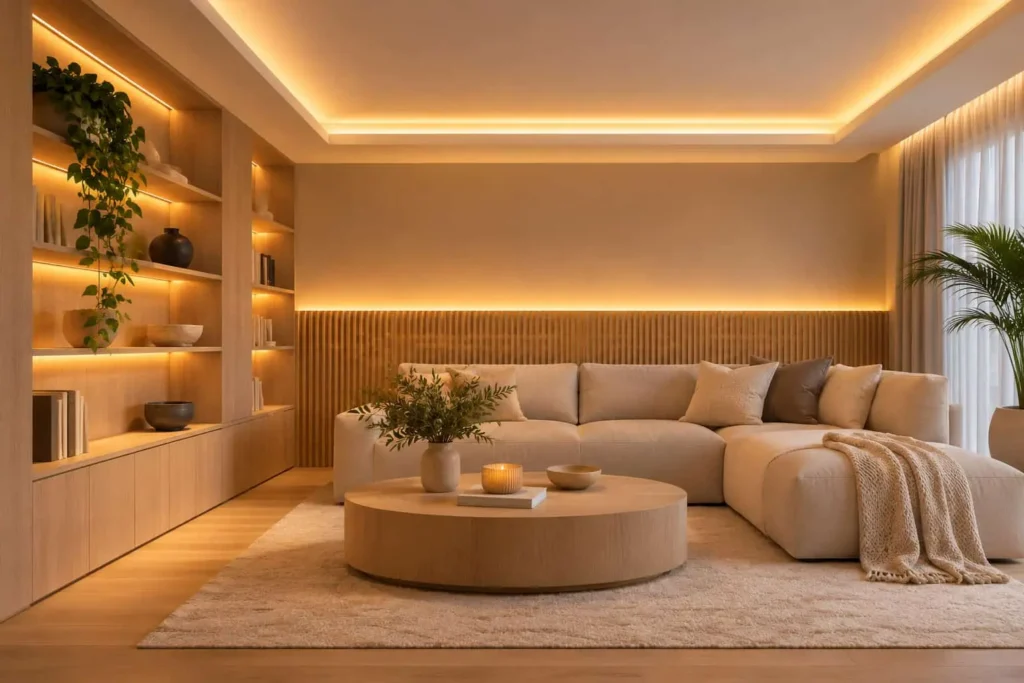
Indirect lighting is a lighting method in which the light source is hidden and its beam is directed at a surface, usually the ceiling or a wall, which reflects it back into the room. The result is diffused light with no glare and no harsh shadows, which makes a space feel more open.
It is one layer of a good lighting design, alongside general and task light, and it is a core part of every lighting system in Marbella that we design.
Indirect vs direct lighting: what is the difference?
The main difference is where the light goes: direct lighting points at the area you want to light, while indirect lighting bounces off a surface before it reaches you. Direct light gives more useful light per watt; indirect lighting creates atmosphere and reduces contrast.
| Feature | Direct lighting | Indirect lighting |
|---|---|---|
| Where the light goes | Straight to the task area | To a ceiling, wall or furniture |
| Effect | Brighter, with defined shadows | Soft, even and glare-free |
| Typical use | Kitchens, bathrooms, desks | Living rooms, bedrooms, corridors, cinema rooms |
| Fittings | Spotlights, pendants, downlights | LED strips in coves, mouldings or profiles |
Types of indirect lighting in the home
The most common types of indirect lighting are defined by the surface that reflects the light: ceilings, walls, furniture and outdoor features. Each needs its own construction detail, so it is best to plan them before ceilings and walls are closed.
Cove lighting on the ceiling
The most popular option. An LED strip is hidden in a plasterboard cove or a perimeter moulding and washes the ceiling with light. As a guide, leave at least 10 cm between the strip and the ceiling so the light spreads evenly instead of forming a hard line.
Wall washing
A strip hidden in a floor or ceiling profile grazes the wall and brings out textures such as stone, timber or microcement. It works especially well behind beds, along corridors and on TV walls.
Outdoor indirect lighting
Under eaves, in planters or along pool edges, always with the right IP rating. It pairs well with pool lights to create a complete evening scene on the terrace.
What do you need to install indirect lighting?
To install indirect lighting you need a good-quality LED strip, an aluminium profile with a diffuser, a correctly sized power supply and a dimming system. The quality of the strip and profile decides whether the light looks seamless or shows visible dots.
LED strip and profile
For long runs, 24 V strips are better than 12 V because they lose less voltage, so the light does not fade at the end. High-density or COB strips mounted in an aluminium profile with an opal diffuser avoid the dotted effect and manage heat better.
Colour temperature and colour rendering
For living rooms and bedrooms we recommend 2,700 to 3,000 K and a colour rendering index (CRI) of 90 or above. If you are unsure, our guide on warm or cool light explains how to choose.
Power supply and dimming
The power supply should have around 20% more capacity than the strip draws. To dim it you need a compatible controller, which we explain in what is a dimmer switch.
Indirect lighting ideas for living rooms and bedrooms
In a living room, indirect lighting works best as ambient light for watching TV or entertaining, combined with reading lamps. In a bedroom, a low, warm light behind the headboard or under the bed replaces the main light late in the evening.
- A perimeter ceiling cove in the living room with a 20% “movie” scene.
- A TV wall washed from above to reduce contrast with the screen.
- A backlit headboard dimmable from the bedside.
The same techniques are the basis of most of our home cinema room ideas.
Planning indirect lighting for your home?
We design and install lighting for villas in Marbella and Malaga, with LED strips, dimming and scenes integrated into your home automation.
How to control indirect lighting with home automation
The easiest way to control indirect lighting is to integrate it into a home automation system with scenes: one button sets the strips, lamps and blinds at the same time. That way indirect lighting stops being decoration and becomes something you use every day.
Scenes can follow the time of day or presence, and you can adjust them from abroad, which is one of the main reasons owners ask us what is a smart home and whether it is worth it. In larger homes we design lighting as part of our integral projects; for a budget guide, read how much it costs to automate a villa in Marbella.
If you would like a lighting design for your property, see our home automation Marbella service, also available as home automation Malaga.
Frequently asked questions about indirect lighting
Does indirect lighting use a lot of electricity?
No. A good LED strip usually draws 9 to 14 W per metre, so a full living room cove uses less power than many older halogen fittings.
Can you add indirect lighting without building work?
Yes, with surface-mounted mouldings or profiles fixed to the ceiling or wall. With building work the result is cleaner, because the strip is completely hidden.
What is the best LED strip for indirect lighting?
A 24 V high-density or COB strip with a CRI of 90 or above, mounted in an aluminium profile with a diffuser. It avoids visible dots and lasts longer.
Can indirect lighting be dimmed?
Yes, as long as the power supply and controller are dimmable. With home automation you can also programme scenes and different levels for each time of day.
