
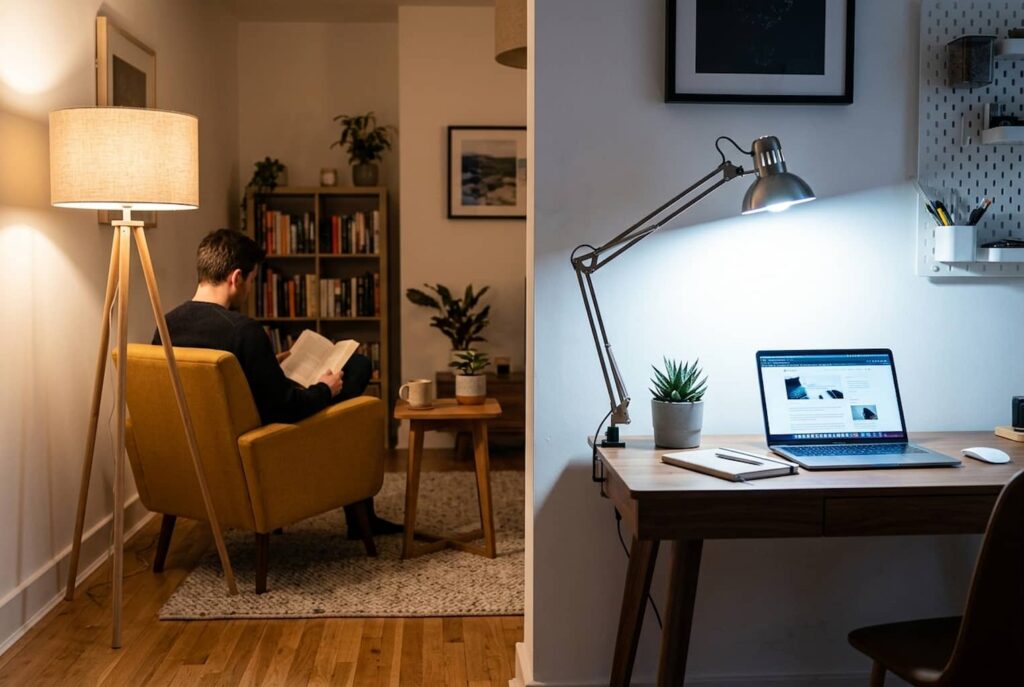
Lighting is probably the most transformative element in any home. It can turn an ordinary living room into a welcoming space, a bedroom into a genuine retreat for rest, or a kitchen into a professional environment where you can cook with precision. However, most people choose their bulbs almost at random, without checking the technical information on the packaging, and end up with rooms that fail to meet their needs: bedrooms with overly stimulating light, kitchens with insufficient illumination for real work, or living rooms that feel like a waiting room.
In this article we explain, drawing on our experience as a specialist in technological solutions for homes and villas in Marbella, how to choose the right colour temperature for each room, what technical factors need to be considered beyond Kelvin degrees, and how smart lighting has completely transformed the possibilities of residential lighting design.
Warm or cool light: what colour temperature actually is
Colour temperature is the property of a light source that determines whether its tone is perceived as warm (yellowish) or cool (bluish). It is measured in degrees Kelvin (K), an SI unit which in this context does not refer to physical heat but rather to visual tone.
The scale works in what may seem a counterintuitive way: the lower the Kelvin value, the warmer the light; the higher the value, the cooler it becomes. The origin of the system lies in a 19th-century experiment by physicist William Kelvin, who observed that heating a metal progressively caused it to change colour: first red, then orange, yellow, white and finally bluish. This same behaviour was used to classify the tone of light sources.
One important point: colour temperature has no relation to power (watts) or light output (lumens). They are independent parameters. Two bulbs with the same lumen output but different Kelvin temperatures produce the same amount of light, but create completely different atmospheres.
Colour temperature ranges and their effects
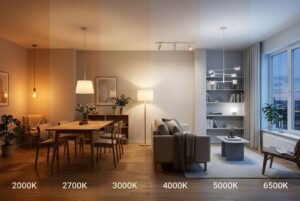
The Kelvin scale typically used in residential lighting ranges from 2000 K to 6500 K. Within this range, three main groups can be distinguished:
Warm light (2700-3000 K)
Emits a golden yellow or amber tone, very similar to that of traditional incandescent bulbs or candlelight. It creates a cosy, relaxing and enveloping feel. It supports the production of melatonin —the sleep hormone— because of its similarity to sunset light, making it the right choice for the hours before rest.
Neutral light (3500-4500 K)
Offers a balanced natural white, close to midday daylight but without appearing cool. It is the most versatile option: it does not tire the eyes, does not distort colour perception and works well in most situations where relaxation and light activity are combined.
Cool light (5000-6500 K)
Emits a bluish white tone, similar to midday sunlight or a clear sky. It is stimulating, activating and very clear. It improves concentration, visibility of fine details and accurate colour reproduction. This is why it is used in demanding professional environments: operating theatres, workshops, laboratories and industrial kitchens.
Comparison table: colour temperature by room
This table summarises the professional recommendation according to the type of space and the main activity carried out in it:
| Room | Recommended temperature | Type of light | Desired feel |
|---|---|---|---|
| Living room | 2700-3000 K | Warm | Cosy and relaxing |
| Master bedroom | 2700 K | Warm | Rest and sleep |
| Children’s bedroom | 2700-3000 K | Warm | Comfort and security |
| Kitchen (ambient) | 3000-4000 K | Neutral | General balance |
| Kitchen (worktops and prep) | 4000-5000 K | Neutral-cool | Precision and visibility |
| Bathroom (ambient) | 3000-3500 K | Warm-neutral | Comfort |
| Bathroom (mirror) | 4000-5000 K | Neutral-cool | Colour accuracy |
| Home office / study | 4000 K | Neutral | Focus without fatigue |
| Dining room | 3000 K | Warm | Sociability and dining |
| Hallways and entrance | 3000-3500 K | Warm-neutral | Welcome and orientation |
| Dressing room | 4000 K | Neutral | True fabric colour |
| Terraces and outdoor areas | 2700-3000 K | Warm | Relaxed atmosphere |
| Home cinema | 2700 K + dimmable | Dimmable warm | Audiovisual immersion |
How to choose lighting for each room

Living room
This is the social heart of the home and its lighting must be flexible. The base should be warm light between 2700 and 3000 K to create a welcoming atmosphere when relaxing or watching television, but it is advisable to include specific accent points with a more neutral temperature (3500-4000 K) for reading corners or side tables where more precise activities take place. Dimming is virtually essential to adapt the light to each moment.
Master bedroom
Warm light throughout, ideally around 2700 K. Cool light in the bedroom inhibits melatonin production and makes it harder to fall asleep. Bedside tables should have warm and dimmable lamps, especially if you read before sleeping. In dressing rooms adjacent to the bedroom, however, a more neutral light (4000 K) is preferable in order to appreciate the real colours of clothing.
Children’s bedroom
Similar to the master bedroom, with warm light as the base. This is especially important for children and adolescents, who are more sensitive to the effect of blue light on the circadian cycle. If there is a study area, it should have a desk lamp with neutral light (4000 K) that does not alter the rest of the environment.
Kitchen
The kitchen is the room that most benefits from combining colour temperatures. General lighting can be neutral (3000-3500 K) for a pleasant atmosphere, but worktops and prep areas require cooler light (4000-5000 K) to see food properly, judge cooking points and work safely. LED strips under wall units are the most common solution.
Bathroom
The bathroom is probably the room with the most nuance. General lighting can be warm-neutral (3000-3500 K) for a comfortable atmosphere during a shower or a relaxing bath. However, mirror lighting should be more neutral or slightly cool (4000-5000 K) to faithfully reproduce the colour of make-up, skin or shaving. This is where many people go wrong and later suffer the consequences in photographs or when going outside.
Home office and study areas
Neutral light (4000 K) is the best option: it provides enough clarity to read documents and work with screens without straining the eyes. Cool light, historically widely used in offices, can cause visual fatigue over long working hours. Combining neutral general lighting with a specific desk lamp greatly improves comfort.
Hallways, entrances and transit areas
Warm-neutral light (3000-3500 K). It should provide enough clarity to move around safely, without being aggressive. In entrances, slightly warmer to create a welcoming feel when arriving home.
Terraces and outdoor areas
Warm light (2700-3000 K) always. In the outdoor areas of luxury villas, with gardens and outdoor living spaces, warm light creates the enveloping atmosphere needed for summer evenings. Cool lighting on terraces detracts from the quality of the space and attracts more insects.
Home cinema
Warm lighting (2700 K) with full dimming control and indirect LED strips to avoid reflections on the screen. Here what matters is not only the temperature but the absolute control over intensity and lighting mood. To complement the acoustic comfort of this type of space, we also recommend our article on how to soundproof a home cinema room, where we address another key pillar of professional home cinema design.
Beyond temperature: other key factors
Choosing well between warm or cool light is only part of good lighting. These are the technical parameters that make the difference between a correct installation and an exceptional one:
Colour Rendering Index (CRI/Ra)
Measures how faithfully a light source reproduces colours compared to natural sunlight, on a scale from 0 to 100. A high CRI means colours look exactly as they really are. Professional recommendations:
- CRI ≥ 80: minimum acceptable in residential settings.
- CRI ≥ 90: recommended in kitchens, bathrooms and dressing rooms.
- CRI ≥ 95: ideal in areas where colour is critical (art galleries, creative workspaces).
Light with a low CRI may have the correct temperature but distort the colours of the environment, reducing the quality of the space.
Lumens: how much light you need
Lumens measure the total amount of light emitted. Guideline recommendations for residential lighting are:
- Living room: 100-200 lumens per m² as ambient base.
- Bedroom: 100-150 lumens per m².
- Kitchen: 300-400 lumens per m² with reinforcement in work areas.
- Bathroom: 200-300 lumens per m² with reinforcement at the mirror.
- Home office: 400-500 lumens per m² in the work area.
Dimming
The ability to adjust intensity transforms any room. A warm light dimmed at night helps prepare for sleep; the same light at full intensity allows work. It is an essential element in any lighting project of medium-high level.
Layering and distribution of light
Professional lighting is made up of three overlapping layers: general lighting (ambient base), task lighting (for specific activities) and accent lighting (to highlight elements: artworks, plants, textures, furniture). Relying on a single ceiling light source is the most common mistake and produces the poorest result.
UGR (glare control)
Parameter measuring the visual discomfort caused by direct glare. In domestic spaces, a UGR below 19 is recommended to avoid nuisance, especially in work areas with screens.
Smart lighting and tunable white

Technology has revolutionised residential lighting. Modern systems allow you to go well beyond the traditional “warm or cool” choice:
- Tunable white. LED bulbs or strips that allow you to adjust colour temperature across a wide range (typically 2700-6500 K) from an app or remote. The same fixture can be warm at night and cool in the morning.
- Circadian lighting. Programmable systems that automatically adjust colour temperature throughout the day to mimic the natural solar cycle: warm at sunrise and sunset, cool at midday. Real benefits for biological rhythm and sleep quality.
- Predefined lighting scenes. Programming of combinations of temperature, intensity and lighting groups for each moment: dinner, reading, cinema, morning, party, security, away mode.
- Integration with home automation systems. Compatibility with KNX, DALI, Zigbee, Matter protocols and complete smart home systems.
- Voice and app control. Compatibility with virtual assistants, smartphone control and automations based on presence, time or events.
These systems are no longer an eccentricity of futuristic homes. In villas and new-build homes or full refurbishments, smart lighting is now part of the expected quality standard. Within our lighting services, we always integrate these technologies from the design stage, coordinating them with the rest of the home’s technical systems.
Common mistakes when choosing colour temperature
- Mixing temperatures without criteria in the same room (a warm pendant light next to cool downlights). This creates visual dissonance.
- Choosing paint under cool site lighting. Colours look very different; always test with the final lighting.
- Ignoring CRI. A correct temperature with low CRI distorts the colours of the environment.
- Using cool light in bedrooms. It interferes with sleep and offers no advantage.
- Confusing Kelvin with physical heat. A “warm” bulb does not heat more than a “cool” one of the same wattage and technology.
- Choosing bulbs by price without checking the technical specs. Cheap bulbs usually have low CRI, short lifespan and poor colour stability.
- Skipping dimming. A space without dimming loses all flexibility.
- Leaving lighting design until the end of the project. It must be integrated from the outset, alongside architectural and interior design.
Professional lighting in villas and homes on the Costa del Sol
In medium and high-end homes, particularly villas on the Costa del Sol and Marbella, lighting has become one of the elements that most impact the perception of quality. A well-planned lighting project transforms the daily experience of living in the house, improves visual comfort, supports biological wellbeing and enhances the perceived value of the property.
As a specialist in technological solutions for homes, at Zapping DH we approach lighting as an integral part of our turnkey projects, coordinating it with the home automation system, sound, climate control and the rest of the installations from the initial design stage. The result is smart spaces that respond to the real needs of their inhabitants and offer the highest quality both in everyday use and in architectural design.
Frequently asked questions about warm or cool light
Can I combine warm and cool bulbs in the same room?
Yes, but only if it responds to a clear criteria. For example, warm ambient light in the living room combined with specific neutral points for reading, or warm general light in the kitchen with cool task light under the wall units. What must be avoided is mixing temperatures without logic within the same visual field, as it creates dissonance and a sense of a poorly resolved project.
Do warm light bulbs consume more than cool light bulbs?
No. Consumption depends exclusively on the wattage and technology of the bulb (LED, halogen, incandescent), not on its colour temperature. A 9 W warm LED bulb consumes exactly the same as a 9 W cool LED bulb. This is one of the most widespread myths and has no real technical basis.
What colour temperature is best for recording video or making video calls at home?
Neutral light around 4000-4500 K is the most recommended, as it reproduces skin tones naturally and balances well with the light from the computer screen. It is essential that the light source has a high CRI (above 90) so that colours appear faithful on camera. Warm light creates yellowish tones and cool light can look too clinical on video.
How can I tell the colour temperature of my current bulbs if I no longer have the packaging?
The most accurate way is to check the reference printed on the bulb itself (manufacturer code) and look it up online. As a rough visual guide, a light that appears clearly yellow is around 2700-3000 K, a warm white slightly amber is usually 3000-3500 K, a neutral white is 4000 K, and a bluish cool white exceeds 5000 K. With practice, you can learn to estimate the temperature fairly well just by sight.
