
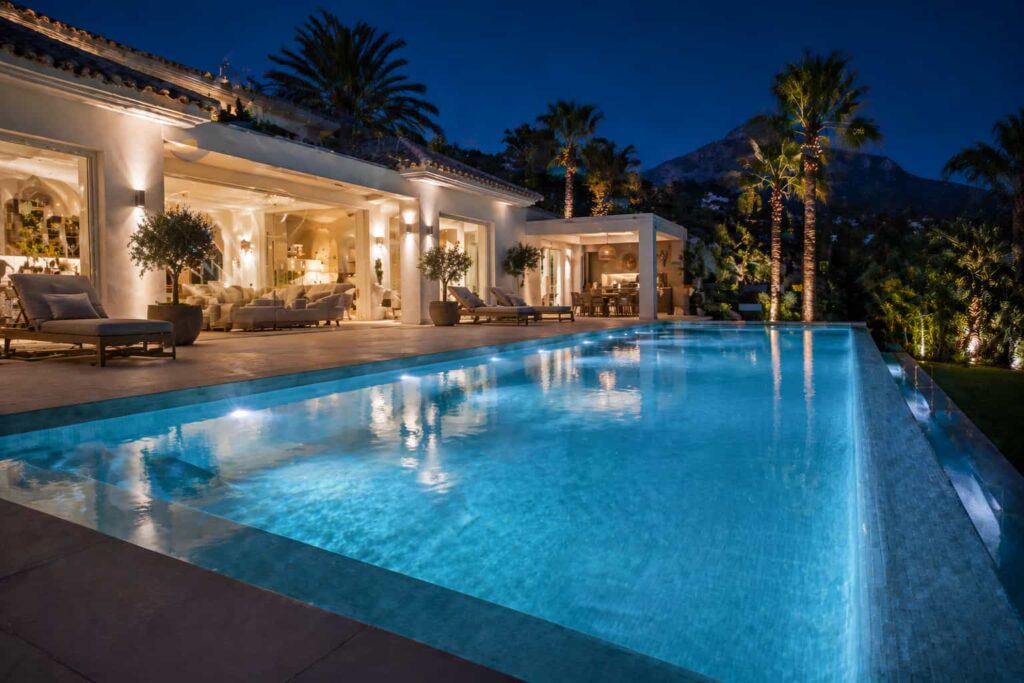
Pool lights are waterproof luminaires designed to operate underwater at a safe voltage of 12V. There are three main types: recessed (niche), surface-mounted and floating. LED technology is today’s standard, offering low energy consumption, a long lifespan and the ability to choose between white light or RGB colours.
A well-lit pool multiplies its aesthetic value, extends its use beyond sunset and turns any outdoor evening into a memorable experience. But choosing the right lighting is not just about aesthetics: it involves understanding the types of installation, the technical safety requirements and the possibilities that current technology offers for intelligent light control.
In this guide we explain everything you need to know to make the best decision.
Pool lights: what they are and why they make a difference
Pool lights are luminaires specifically designed to operate in aquatic environments, either submerged in the water or around the pool surround. Unlike conventional lighting, they must meet strict waterproofing, safety voltage and chemical resistance requirements.
Well-planned underwater lighting provides:
- Safety: improves visibility inside the water, especially in deep pools or those with steps.
- Aesthetics: transforms the appearance of the pool at night, creating visual effects that enhance the garden and property design.
- Functionality: allows the pool to be used at night in complete comfort.
- Property value: in luxury villas and residences, a properly lit pool is a differentiating element that increases the perceived value of the property.
Types of pool lights: which to choose based on your installation
The choice of light type depends mainly on how your pool is built and whether a pre-installation already exists. There are three main categories:
Recessed LED lights (niche)
The most common option in new-build pools or those with pre-existing installation. They integrate directly into the pool wall, offering a clean and fully integrated appearance. The light sits flush with the wall and the only visible element is the bezel.
This is the most durable and professional option. It requires access to a pre-installed niche in the concrete or liner of the pool.
Surface-mounted LED lights
Fixed directly onto the pool wall without the need to drill or create a niche. Ideal for renovations or pools without pre-installation. Installation is faster and more affordable than recessed lights, and in many cases does not require completely draining the pool.
Floating pool lights
Floating pool lights require no electrical installation: they run on rechargeable batteries and float on the water’s surface. Perfect for one-off events, smaller pools or as complementary decorative lighting. Battery life varies by model, generally between 8 and 20 hours per charge.
LED vs. halogen technology: the difference is clear
LED technology has almost entirely replaced traditional halogen lights in pool lighting. The reasons are compelling:
| Feature | LED | Halogen |
|---|---|---|
| Energy consumption | Very low (7–24W) | High (300–500W) |
| Lifespan | 30,000–50,000 hours | 2,000–4,000 hours |
| Water temperature | Does not heat the water | Generates heat |
| Colours available | Full RGB + whites | White only |
| Maintenance | Minimal | Frequent |
| Long-term cost | Very economical | High |
If your pool still has PAR56 halogen lights, switching to LED is straightforward in most cases: the LED PAR56 bulb is compatible with the existing niche and 12V AC transformers.
Pool light colours: effects and when to use each one
The ability to choose lighting colour is one of the most valued aspects of modern pool lighting. RGB systems can generate thousands of shades and dynamic effects. This table summarises when to use each option and what effect it achieves:
| Colour / Mode | Temperature | Visual effect | Best for |
|---|---|---|---|
| Cool white | 5,000–6,500K | Maximum visibility, enhances the blue of the water | Safety, sport or family pools |
| Warm white | 2,700–3,000K | Intimate and sophisticated atmosphere | Luxury villas, terraces with warm lighting |
| Blue | RGB | Enhances the natural water colour, sense of depth | All pool types, the most popular choice |
| Green / Turquoise | RGB | Evokes a natural lagoon, landscaped aesthetic | Lush gardens, natural-style pools |
| Multicolour / Dynamic effects | RGB | Sequences, transitions, music synchronisation | Events, entertainment, smart home integration |
Practical rule: use cool white or blue as the main lighting for larger pools, and reserve RGB multicolour for decorative areas, steps or jacuzzis. In large pools, RGB alone can leave dark areas if not combined with white light.
How many lights does my pool need?
The number of lights depends on the pool size, the output of each light and the desired effect. As a general guide:
- Small pools (up to 25 m²): 1–2 lights of 12–18W.
- Medium pools (25–50 m²): 2–3 lights, placed on opposite sides to avoid dark spots.
- Large pools (over 50 m²): 4 or more lights distributed around the perimeter.
- General rule: 1 light per 15–20 m² of water surface area.
Installation depth also matters: lights should be placed approximately 70 cm below the water surface, ensuring optimal light distribution and preventing glare for swimmers.
Where to position the lights: strategic placement
- Rectangular pool: lights at the short ends, facing each other, for uniform coverage without central shadows.
- Irregular pool: distribute lights along the sides following the contour, with special attention to the deepest areas.
- Pools with steps: at least one light directed towards the access area to improve safety.
- Orientation: in pools close to the house, direct lights away from the building to avoid glare from inside.
Technical requirements and safety
European electrical safety regulations require that underwater lighting must always operate at 12V, never directly at 230V. This means a suitable transformer must be installed between the mains supply and the lights.
- IP68 protection rating: essential for any submersible light.
- 12V transformer: can be AC or DC depending on the light model.
- Waterproof junction boxes: all connections must be made in approved waterproof enclosures.
- Installation by a qualified professional: any electrical work in water environments must be carried out by a certified electrician.
Smart pool lighting: the next level
Integrating pool lighting into a smart home system is arguably the biggest qualitative step you can take in managing your outdoor space. With a smart system you can control on/off from your phone, create personalised lighting scenes, set automatic schedules and synchronise your pool lighting with outdoor music or the rest of the property.
If you have a pool and want to integrate its lighting into a complete smart home system, our smart home installation in Marbella service offers solutions specifically designed for residences in this area. If your project is elsewhere in the province, we also develop smart home systems for villas to the same standards of quality and service.
And if you are looking to design a complete lighting experience for your entire property, take a look at our lighting design project in Marbella service: we design the exterior and interior lighting of your villa in an integrated way, from pool lights to garden and driveway illumination.
Frequently asked questions about pool lights
Can lights be installed in an existing pool without draining it?
It depends on the type of light. Surface-mounted lights can be installed by lowering the water level below the installation point, without fully draining the pool. Recessed lights that require creating a niche in the concrete do require draining. Floating lights require no installation at all and can be used with the pool full.
What happens if an LED pool light stops working?
In most modern cases, the light is replaced as a complete unit. If it is a PAR56 recessed light, the bulb can be changed without removing the niche. Always replace with a model of the same specifications (voltage, connector) to ensure compatibility with the existing transformer.
Do LED pool lights work with saltwater?
Yes, as long as they carry IP68 certification and are made from corrosion-resistant materials (stainless steel, polycarbonate, epoxy resins). Always check the manufacturer’s technical datasheet to confirm compatibility with saltwater chlorination systems, as some lower-range models may deteriorate prematurely in this environment.
Can I control pool lights from my phone without a full smart home system?
Yes. There are pool-specific RGB control systems with WiFi or Bluetooth connectivity that allow you to manage colour, intensity and effects from an app without needing a centralised smart home system. These are a very popular intermediate solution for those who want advanced functionality without investing in full smart home infrastructure.
