
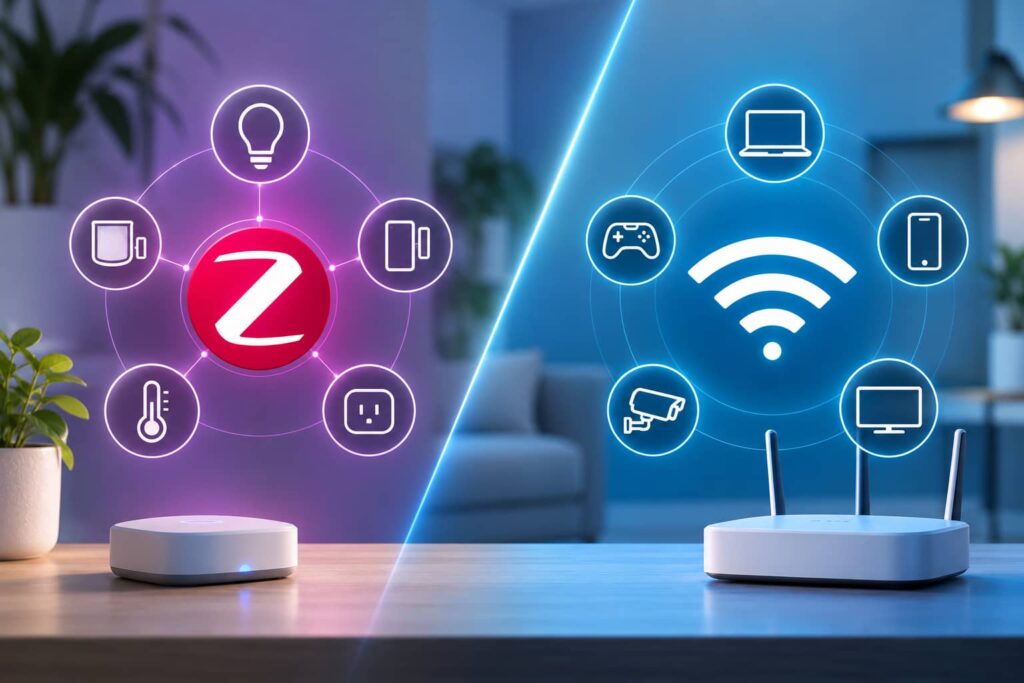
Quick answer: in the Zigbee vs WiFi debate, Zigbee is usually better for battery-powered sensors, switches and lights because it uses very little power and builds its own mesh network. WiFi is better for devices that move a lot of data, such as cameras and speakers. Most well-designed smart homes use both.
If you are planning a smart home in Spain, or upgrading a villa you manage from abroad, choosing the right wireless protocol decides how reliable the system will feel day to day. This guide compares Zigbee vs WiFi in plain language: how each one works, where each one fits and how they live alongside newer standards such as Matter.
What is the difference between Zigbee and WiFi?
Zigbee is a low-power wireless protocol designed for small smart home devices; it sends tiny amounts of data, needs a hub and forms a mesh in which devices relay messages to each other. WiFi is the same network your phone and laptop use: fast, hub-free, but more power-hungry and dependent on the router.
Zigbee is based on the IEEE 802.15.4 standard and is maintained by the Connectivity Standards Alliance, the organisation previously known as the Zigbee Alliance. WiFi is based on the IEEE 802.11 family of standards. Both commonly use the 2.4 GHz band, which is why channel planning matters in a busy home.
Zigbee vs WiFi: side-by-side comparison
The quickest way to compare Zigbee vs WiFi is to look at power use, speed, the need for a hub and how each network behaves as you add more devices. Zigbee wins on battery life and scalability for small devices; WiFi wins on bandwidth and simplicity for single gadgets.
| Feature | Zigbee | WiFi |
|---|---|---|
| Standard | IEEE 802.15.4 | IEEE 802.11 |
| Data rate | Up to 250 kbps | Hundreds of Mbps or more |
| Power use | Very low; sensors can run for years on a battery | Higher; most devices need mains power |
| Hub required | Yes, a Zigbee coordinator or hub | No, connects straight to the router |
| Network type | Mesh: mains-powered devices repeat the signal | Star around the router, or a mesh WiFi system |
| Best for | Sensors, switches, smart bulbs, blind motors | Cameras, speakers, TVs, video doorbells |
When is Zigbee the better choice?
Zigbee is the better choice when you want many small devices that must run on batteries or respond instantly: door and window sensors, motion detectors, wireless switches, smart bulbs and some blind motors. Because each mains-powered Zigbee device repeats the signal, the network gets stronger as you add more of them.
Battery life
A Zigbee sensor can often last a year or more on a coin cell.
Less router load
Dozens of Zigbee devices do not crowd your WiFi network.
Local control
Many Zigbee hubs keep working without an internet connection.
The trade-off is that you need a hub, and devices from different brands do not always expose every feature through every hub.
When is WiFi the better choice?
WiFi is the better choice for devices that stream video or audio, or that you only need one or two of, because they plug straight into the router without a hub. Security cameras, video intercoms, multi-room speakers and smart TVs all need the bandwidth that only WiFi or a cable can provide.
The coverage problem in large villas
The weak point is coverage. In a large villa with thick walls and outdoor areas, a single router will not reach the pool, the garage or the garden cameras. That is why a professional installation usually combines cabled access points or mesh WiFi with low-power protocols for sensors. If you are planning a full renovation, it is also worth thinking about wired systems, as we explain in our guide on how to install home automation.
Not sure which protocol your home needs?
We design and install smart home systems for villas in Marbella and Malaga, combining wired and wireless devices you can control from anywhere.
Where does Matter fit in the Zigbee vs WiFi choice?
Matter is a newer standard that lets devices from different brands work together. It runs over WiFi, Ethernet and Thread, but not over Zigbee. Existing Zigbee devices can still join a Matter home through a compatible bridge, so choosing Zigbee today does not lock you out of Matter.
We cover the standard in more detail in what is Matter in home automation. In practice, the decision is less “Zigbee or WiFi” and more “which protocol for which job”.
Which protocol is best for a holiday home or rental property?
For a home you manage from abroad, reliability matters more than gadget count. A mix works best: Zigbee or wired sensors for leaks, doors and temperature, which keep working if the internet drops, and WiFi or cable for cameras and remote access. Every device should be reachable from one app.
Typical set-ups we see in second homes on the Costa del Sol include automated blinds that close in strong sun, heating that switches on before you land and alerts if water is detected. Our guides on how to automate your home blinds and how to automate home heating show what is possible. If you would like a system designed around your property, see our home automation Marbella service, also available as home automation Malaga.
Frequently asked questions about Zigbee vs WiFi
Is Zigbee more reliable than WiFi?
For small sensors and switches, usually yes: Zigbee builds a mesh in which mains-powered devices repeat the signal, and it does not compete with phones and laptops for router capacity.
Do Zigbee devices interfere with WiFi?
Both can use the 2.4 GHz band. Choosing a Zigbee channel that does not overlap with your WiFi channels avoids most interference.
Can I use Zigbee without a hub?
No. Zigbee devices need a coordinator, which can be a dedicated hub or a smart speaker or controller with a built-in Zigbee radio.
Should I choose Zigbee or WiFi smart bulbs?
If you plan more than a handful of bulbs, Zigbee is usually the better option, because it keeps the load off your WiFi router and forms a stronger mesh as you add lights.
