
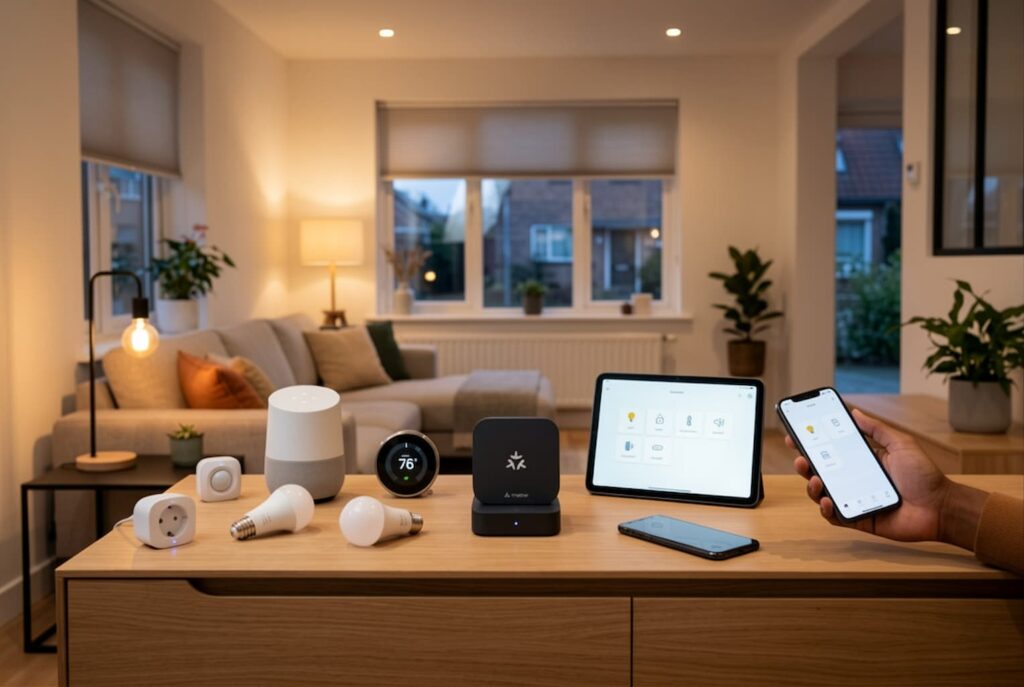
If you’ve recently started looking into home automation, you’ve almost certainly come across one term popping up everywhere: Matter. It’s on boxes of smart bulbs, on smart speakers, on thermostats, on door locks. And the natural question is: what exactly is Matter, what does it change compared to what existed before, and why has it become, in 2026, the protocol that every major manufacturer is adopting? The short answer is that Matter is the standard finally bringing order to a decade of incompatibilities, closed ecosystems and duplicated apps.
In this article we explain, from the experience of a company specialised in technological solutions for homes and villas in Marbella, what Matter is, how it works, which devices use it and why it’s changing the rules of the smart home. Whether you’re starting out with home automation or you already have an installation and want to understand where it’s heading, this article will give you a clear, up-to-date overview.
What is Matter in home automation: definition and origin of the standard
Matter is an open connectivity standard for smart home devices, developed jointly by more than 300 companies under the umbrella of the Connectivity Standards Alliance (CSA). Behind the project are the tech industry giants: Apple, Google, Amazon, Samsung, IKEA, LG, Microsoft, Philips and many other manufacturers that were incompatible with each other for years.
Its origins date back to December 2019, when it was announced as “Project CHIP” (Connected Home over IP). Version 1.0 was launched in October 2022 and, since then, it has evolved rapidly:
- Matter 1.0 (October 2022): bulbs, plugs, switches, basic sensors, locks and thermostats.
- Matter 1.2 (2023): white goods (washing machines, tumble dryers, dishwashers, ovens).
- Matter 1.3 (2024): robot vacuum cleaners, electric vehicle chargers, energy sensors.
- Matter 1.4 (2024-2025): improvements in presence sensors with radar/mmWave technology, advanced energy management.
- Matter 1.5 (2026): native support for security cameras, moisture sensors for irrigation, garage doors, advanced energy management systems.
In 2026 there are more than 4,000 certified devices and the list grows every week. Matter has gone from being a promise to becoming the de facto standard of home automation.
How Matter works: the secret is in its architecture
A very common misconception is to think Matter is a new wireless protocol, like Zigbee or Z-Wave. It isn’t. Matter is a common language that runs on top of existing network technologies:
- Wi-Fi. For devices needing high bandwidth (cameras, speakers, hubs).
- Thread. Low-power mesh network, ideal for sensors, bulbs and switches. Faster and more stable than Wi-Fi for these devices.
- Ethernet. For reliable wired connections (hubs, fixed controllers).
- Bluetooth Low Energy (BLE). Used only for the initial device setup.
Matter runs on IPv6, which means every device has its own IP address and can communicate directly with others without going through the cloud. This delivers three decisive advantages over previous systems:
- Local control. Commands are executed directly between devices in the home, without external servers. Home automation works even without an internet connection.
- Lower latency. Without depending on the cloud, the response is virtually instant.
- Greater privacy. Data doesn’t leave the local network unless the user decides otherwise.
This architecture is what makes Matter a genuinely different proposition from anything that came before.
The main advantages of Matter over other protocols
To understand why Matter is changing home automation, it helps to review the problems that existed before and how Matter solves them:
Real interoperability
Before Matter, every manufacturer had its own ecosystem. A Philips Hue bulb worked with Apple Home, but only if you used the Philips Bridge. A lock compatible with Alexa wasn’t necessarily compatible with Google. The result: duplicated apps, stacked hubs and brand-locked purchases. With Matter, a certified device works natively with Apple Home, Google Home, Amazon Alexa and Samsung SmartThings at the same time, without adapters or extra bridges.
Local operation
Matter devices don’t rely on the manufacturer’s cloud to function. If a Chinese brand shuts down its servers tomorrow, your bulb will keep working. This is a structural change: the smart home stops depending on remote companies for basic tasks.
Much simpler setup
Setting up a Matter device is as straightforward as scanning a QR code with your phone. The device automatically appears in your control app and becomes available across every ecosystem you have configured. No separate accounts, no endless steps.
Security by design
Matter includes end-to-end encryption, strong authentication and zero-trust architecture. Only genuine devices can join the local network, which drastically reduces the risk of intrusion through vulnerable smart home entry points.
Future-proof compatibility
Matter 1.0 devices still work with the latest versions thanks to the backward compatibility guaranteed by the CSA. You buy today and stay covered for years. Something rare in a sector where technical obsolescence used to be the norm.
Comparison table: Matter vs Zigbee, Z-Wave and Wi-Fi
To better understand what Matter brings, this table summarises the key differences between the main home automation protocols today:
| Feature | Matter | Zigbee | Z-Wave | Wi-Fi |
|---|---|---|---|---|
| Protocol type | IP-based interoperability standard | Proprietary mesh network | Proprietary mesh network | Standard home network |
| Needs a hub | Only for Thread devices | Yes (always) | Yes (always) | No |
| Works without internet | Yes (local control) | Yes (with hub) | Yes (with hub) | Depends on device |
| Multi-brand interoperability | Full | Limited to hub | Limited to hub | Limited to ecosystem |
| Energy consumption | Varies by underlying network | Very low | Low | High |
| Best for | Interoperable, future-proof home | Sensors and legacy devices | Sensors and premium installations | Cameras and high-power devices |
The practical conclusion is that Matter doesn’t replace other protocols: it unifies them. In a modern smart home, all of them coexist: Wi-Fi for cameras and speakers, Thread for sensors and bulbs, and Matter as the common language allowing everything to communicate.
Which devices are compatible with Matter in 2026
With Matter 1.5 launched in 2026, the list of compatible devices has grown considerably. These are the main categories:
- Lighting. Smart bulbs, LED strips, dimmers, switches.
- Smart plugs. With electricity consumption monitoring.
- Thermostats and climate control. Heating, air conditioning and underfloor heating control.
- Motorised blinds and curtains. With schedule-based or sensor-driven automations.
- Smart locks. With access logs and remote control.
- Sensors. For temperature, humidity, presence, contact, air quality and water leaks.
- Security cameras. One of the key additions in Matter 1.5.
- Garage doors and exterior motors.
- Energy management systems. EV wallbox chargers, solar panels, tariff managers.
- White goods. Washing machines, dishwashers, ovens, dryers from selected ranges.
- Robot vacuum cleaners.
- Smart irrigation systems. With soil moisture sensors.
Brands such as Philips, IKEA, Eve, Nanoleaf, Yale, Aqara, TP-Link, SwitchBot, Meross, Bosch and Schneider already have extensive certified catalogues. The key is always to look for the “Works with Matter” or “Matter Ready” badge on the packaging before buying.
What you need to build a Matter smart home
To start setting up a Matter home you don’t need to throw away what you already have. You only need three basic elements:
- A Matter controller (hub). A compatible smart speaker or display: Google Nest Hub, Apple HomePod, Amazon Echo (4th gen or later), Samsung SmartThings Hub or similar. This is the “brain” of your home.
- A Thread Border Router. Needed if you want to use Thread devices (low-power sensors and bulbs). Many modern smart speakers already include it.
- Matter-certified devices. Bulbs, plugs, sensors, locks… choose what you need according to your home’s priorities.
The setup process is very straightforward: you switch the device on, scan the QR code with the app of your preferred ecosystem (Apple Home, Google Home, Alexa or SmartThings), and within a minute it’s integrated and ready to use. No accounts, no intermediate steps, no frustration.
Matter in professional home automation projects for villas
So far we’ve talked about Matter from the perspective of the home user, where the standard allows you to buy individual devices and combine them. But in more ambitious projects —luxury homes, villas, residential buildings— Matter is integrated as one more layer within much more complex professional installations.
In a villa with a complete home automation system in Marbella, Matter coexists with other professional protocols (KNX, BACnet, proprietary security and climate systems) and is used mainly to integrate everyday domestic devices (white goods, decorative lighting, sensors) under a single control panel. The advantage is enormous: the user manages everything from the same app they use to play music or adjust the temperature, regardless of who manufactures each device.
In comprehensive home automation projects in Málaga, this Matter + professional protocols integration is what gives homeowners a truly intelligent home, with a straightforward user experience, no dependency on a single manufacturer’s cloud and, above all, prepared for the future. When new categories of certified devices appear —and Matter 1.6 already promises more— it will be enough to add them, not to redesign the entire system.
Current Matter limitations worth knowing
Although Matter has come a long way, it still has genuine areas for improvement that are worth being honest about:
- Not all categories are covered yet. Some specific white goods and advanced multi-room audio systems are still missing.
- Some “compatible” devices still require their proprietary hub. Which somewhat contradicts the spirit of the standard.
- Multi-controller setup can be confusing. If you want the same device to appear simultaneously in Apple Home, Google Home and Alexa, the steps aren’t always intuitive.
- Not all older devices can be updated. Some can (Philips Hue with Bridge v2, Eve, Nanoleaf, SwitchBot); others can’t, depending on the hardware.
- Some brands implement Matter only partially. Basic functions may be enabled, but advanced features remain locked to the proprietary app.
Knowing these limitations is important for making informed decisions. Even with them, Matter remains, by some margin, the best long-term bet for any smart home.
Why Matter is the safe bet in home automation for the years ahead
After a decade of incompatibilities, overlapping hubs, duplicated apps and devices that stopped working when a brand closed its servers, Matter delivers exactly what home automation needed: a common language, local control, real security and universal compatibility. Backed by every major player in the sector and with over 4,000 certified devices, its consolidation is guaranteed.
If you’re thinking of moving to a smart home —either to start a new installation or to evolve an existing system— the recommendation is clear: always prioritise Matter-certified devices. You secure present and future compatibility, avoid vendor lock-in and build an infrastructure that will remain valid for many years to come. And, if your project is ambitious, working with a professional integrator combining Matter with advanced systems is the way to make sure the result is truly memorable.
Frequently asked questions about Matter in home automation
Do I need to replace all my current devices to use Matter?
Not necessarily. Matter coexists perfectly with existing protocols such as Zigbee, Z-Wave or Wi-Fi in most modern hubs. Some older devices (Philips Hue with Bridge v2, Eve, Nanoleaf, SwitchBot) have received firmware updates to become compatible. For the rest, the sensible approach is to keep what you have and, as you replace devices, always prioritise those with the Matter badge.
How much does a Matter device cost compared to a traditional one?
There’s barely any difference. A Matter smart plug typically costs €15-25, a compatible bulb starts from €10, and a Thread Matter motion sensor from €25-40. Brands like IKEA, Aqara and SwitchBot have invested heavily in highly accessible pricing, which has popularised the standard. Premium ranges (Philips Hue, Eve, Nanoleaf) cost a bit more, but the premium is justified by quality and durability.
Will Matter work without internet in my home?
Yes, that’s actually one of its biggest advantages. Matter devices communicate locally through your Wi-Fi or Thread home network, without external servers. The automations you’ve set up (turning on lights when motion is detected, adjusting the thermostat by time of day) will keep working even if your connection drops. Only remote control from outside the home requires internet.
Is Matter compatible with voice assistants like Alexa, Siri and Google Assistant?
Yes, with all three at the same time. That’s the key difference compared to before: a single Matter device can be controlled simultaneously from Alexa, Siri (Apple Home), Google Assistant and Samsung SmartThings, with no need to commit to a single ecosystem. This gives users complete freedom to combine platforms according to the preferences of each family member or each room of the home.
