
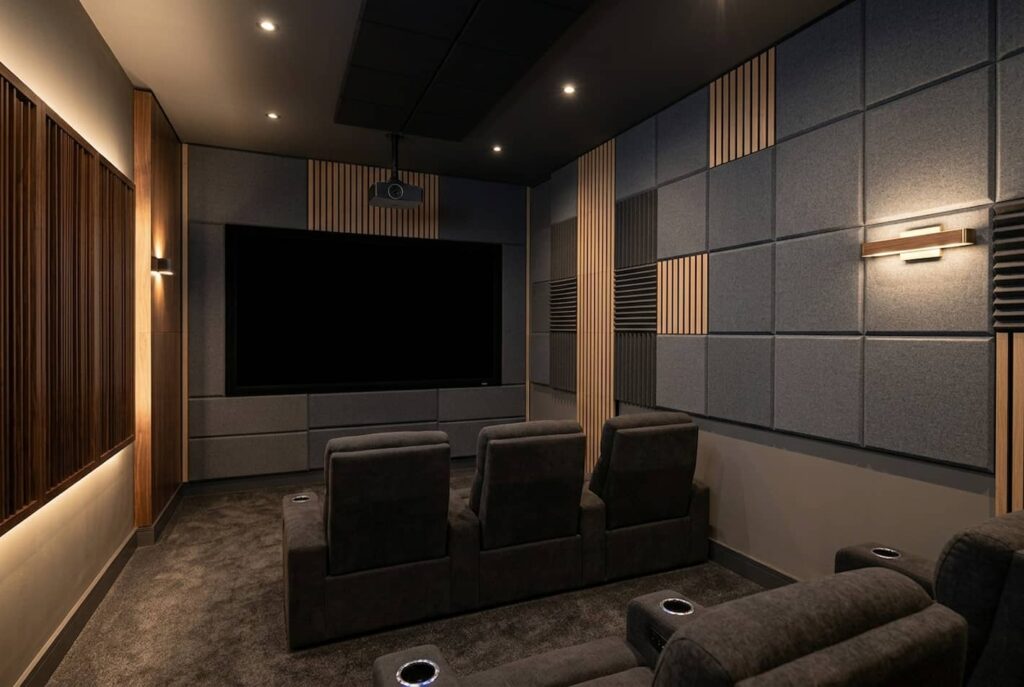
This article is a practical guide to understanding how to soundproof and acoustically treat a home cinema room. We explain the difference between these two concepts, which materials actually work, what mistakes to avoid, and why in high-end villas and residential projects it pays to address it from the start, integrated with the rest of the installations (climate control, lighting, home automation and AV).
How to soundproof a room: what it really means
Before we talk about materials and solutions, it’s worth clearing up a very common confusion: soundproofing and acoustic treatment are not the same thing. They are two different objectives, with different techniques and materials:
- Soundproofing (acoustic insulation): prevents sound from leaving the room and reaching other spaces, or from entering from the outside. It’s the “box within a box” that stops the neighbours, the rest of the house or street noise from interfering with the experience.
- Acoustic treatment: improves the sound quality inside the room. It eliminates reverberation, absorbs echoes, manages bass frequencies and ensures that every seat has clear, balanced audio.
A good home cinema project needs both. Only soundproofing without treating the room produces a silent space with echo and metallic sound. Only treating acoustically without insulating gives a room with good internal quality, but one that “leaks” audio into the rest of the house and is contaminated by external noise at the same time.
Applicable regulations in Spain
Beyond personal comfort, there are regulations that apply to any renovation or construction with acoustic impact:
- Law 37/2003 on Noise and its implementing regulation (Royal Decree 1367/2007). Regulates acoustic pollution in residential areas.
- Basic Document HR (DB-HR) of the Technical Building Code. Sets the minimum acoustic insulation values between dwellings and against external noise.
- Local ordinances. In Marbella and many Costa del Sol municipalities, there are specific regulations on noise hours and permissible levels in residential areas.
The international technical reference standards (such as THX or Dolby Atmos Home) go further and define optimal insulation and treatment levels for professional cinematic experiences at home.
How to soundproof the room step by step
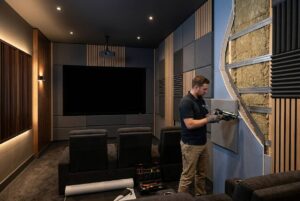
Properly soundproofing a home cinema room means working on every surface that defines it. If one is left untreated, it becomes the “weak point” through which sound will escape, ruining the effort put into the rest.
1. Walls
The most common technique is self-supporting drylining with plasterboard on a metal frame, filled with rockwool or mineral wool. For higher demands, double plasterboard with a damping layer in between (such as Green Glue) or specific high-density boards are used. In premium projects, the “box-in-a-box” concept is applied: a new structure completely decoupled from the original one by silent blocks.
2. Floor
One of the points where the most structural noise is transmitted. A floating floor is recommended, with a perimeter band of resilient material (crosslinked polyethylene, technical rubber) and a damping layer under the flooring. If there’s also a subwoofer, it’s essential: bass frequencies transmit through structural vibration far more than through the air.
3. Ceiling
A suspended false ceiling with absorbent material (rockwool or mineral wool) decoupled from the original structure. It’s especially critical in multi-storey homes or flats with neighbours above: without a good ceiling, any explosion in the film will be heard upstairs as if they were sitting next to the speakers.
4. Doors
Standard doors offer barely 30-35 dB of insulation. For a serious home cinema you need to install specific acoustic doors (with perimeter seals, automatic drop-down sills and a dense core), which exceed 40-50 dB. It’s one of the most expensive components and also one of the most decisive.
5. Windows
Ideally, the room shouldn’t have windows. If it does, the optimal solution is double or triple acoustic glazing with air cavities of different thicknesses, hermetic frames and acoustic seals. You can also opt to block them off with removable solutions if the room is shared with other uses.
6. Electrical and HVAC installations
Sockets, junction boxes and ventilation grilles are commonly overlooked points of acoustic leakage. Sealed acoustic back boxes are used, and HVAC ducts must be treated with silencers and a “Z” routing to prevent direct transmission.
Acoustic treatment: what a cinema room needs
Once you’ve achieved insulation, you need to treat the interior. The technical objectives are to control reverberation (measured as RT60), absorb unwanted reflections and properly manage low frequencies. The typical elements are:
- Absorbent panels. Placed at the primary reflection points (side walls opposite the listening position, ceiling above the seats) to eliminate echoes and improve dialogue clarity.
- Bass traps. Placed in the corners of the room, where low frequencies accumulate. Without them, bass response is uneven and subwoofers perform far worse than expected.
- Acoustic diffusers. On the rear wall and in specific areas. They distribute sound energy in multiple directions without absorbing it, keeping the sensation of a “live” room.
- Balanced absorption. Neither too little nor too much. Excessive absorption creates a “dead” room that sounds artificial; too little leaves a room with echo. The balance is a technical exercise.
- Textiles and decorative elements. Thick rugs, heavy curtains and upholstered seating also contribute to absorption and to the cinematic aesthetic.
Acoustic treatment is where the difference is most noticeable between a professional audio and video installation and an amateur setup. It’s calculated using specific software and fine-tuned afterwards with calibrated microphones and frequency response analysis.
Common mistakes when soundproofing a home cinema
Mistakes we frequently encounter in projects that come to us after defective renovations:
- Sticking foam or open-cell material directly onto the walls. It’s the most popular solution in DIY tutorials and one of the least effective: it barely improves insulation (only a few dB) and doesn’t control bass.
- Treating only walls and ignoring ceiling and floor. Sound escapes through any untreated path. Insulating only three surfaces leaves 25% of the work undone.
- Confusing soundproofing with acoustic treatment. Buying absorbent panels expecting them to isolate you from the neighbour’s noise is a classic frustration.
- Not insulating doors and windows. A standard door lets through more noise than an entire well-treated wall. Without acoustic doors, everything else is wasted.
- Forgetting climate control and ventilation. Air ducts are motorways for sound. Without silencers and proper routing, insulating the rest is largely useless.
- Designing the room without considering the equipment. The number of speakers, power output and layout completely condition the treatment. A modest 5.1 is not the same as a high-power 7.2.4 Dolby Atmos system.
- Not planning for wiring and home automation. Improvising cable runs after the renovation forces you to break through the very insulation you’ve just installed. Cabling must be planned from the outset alongside the acoustic project.
A good acoustic project integrated with the rest of the installations (silent climate control, dimmable lighting, AV cabling, home automation) avoids all these mistakes. It’s the main reason why, in high-end residential projects, we recommend approaching the home cinema within an integral project service from the initial renovation phase.
How much does it cost to soundproof and treat a home cinema room
Costs vary enormously depending on the level of demand and the dimensions of the room. These are orders of magnitude for a 20-30 m² room:
- Basic level (€5,000-10,000). Moderate insulation: drylining on main walls, suspended false ceiling, basic acoustic treatment. Enough for detached homes or ones with neighbours who aren’t especially noise-sensitive.
- Mid-range level (€10,000-25,000). Serious insulation on all surfaces, acoustic door, acoustic treatment with simulation software, bass management and silent ventilation. The most common level in private villas and high-end homes.
- High-end level (€25,000-60,000+). Complete “box-in-a-box” solution with full structural decoupling, certified acoustic doors, professional cabling, Dolby Atmos 7.2.4 or higher systems, DALI lighting, integrated silent climate control and cinematic scene automation. Reference room with professional projection quality.
These costs don’t include AV equipment (projector, speakers, processor, seats), which can add anything from €8,000 in simple configurations to more than €100,000 in top-tier installations.
Home automation integration: the key to a real experience
A modern home cinema isn’t just audio and insulation: it’s also dimmable lighting (ideally DALI or KNX), silent climate control, automated blinds, motorised projector and home automation scenes that prepare the room at the touch of a button (lights at 10%, curtains closed, air conditioning on, projector down, inputs configured). All of this is part of the immersive experience just as much as the sound.
The seamless integration between these systems is becoming easier thanks to new interoperability standards. If you’d like to explore how Matter is simplifying the connection between devices from different manufacturers in residential projects, we recommend our article on what Matter is in home automation, where we explain how this protocol is transforming smart home installations.
When it pays to tackle soundproofing with a professional
Insulating and acoustically treating a room isn’t a DIY project for medium-high end homes. These are the situations in which calling a professional integrator saves time, money and frustration:
- When the room is part of a full renovation. It’s far more efficient to execute everything at once than to renovate twice.
- When the home is adjacent to others (flat, terraced house, apartment in a resort) and insulation must reach high levels by law.
- When the room includes serious AV equipment (Dolby Atmos, powerful subwoofers, 7.2.4 systems or higher) that require professional treatment to deliver their full potential.
- When you’re looking for home automation integration, dimmable lighting, climate control, curtains and scene automation.
- When the property is a villa or high-end project where the home cinema is just one piece of a broader experience.
Our team designs and installs private rooms within a residential cinema room integrated with the rest of the home, coordinating insulation, acoustic treatment, AV, lighting, climate control and automation in a single project. It’s the only way to ensure everything works as it should when the user presses a button and the lights dim.
Frequently asked questions about home cinema soundproofing
Can a room be soundproofed without construction work?
Partially, yes. You can install freestanding acoustic panels, heavy curtains, thick rugs and door and window seals to reduce sound leakage. However, for serious insulation (more than 45-50 dB of improvement) construction work is essential: drylining, suspended ceilings, acoustic doors and floating floors. Non-invasive solutions work well to improve internal acoustic comfort, but don’t achieve real insulation towards the outside.
How long does it take to soundproof a complete room?
For a 20-30 m² room with a professional project, between 3 and 6 weeks of construction if serious insulation is being done. It depends on the availability of specific acoustic materials (acoustic doors and windows usually have 4-8 week lead times), the scope of the renovation and whether it’s integrated with climate control and home automation. A medium-sized villa project with full AV integration usually closes in 8-12 total weeks.
Is a rectangular or square room better for home cinema?
Rectangular, with an approximate 1:1.6:2.5 ratio (acoustic golden ratio), is considered the most balanced to minimise room modes. Square rooms or those with unbalanced proportions concentrate resonances at specific frequencies, which are harder to correct. If you can’t choose the shape, good acoustic treatment can compensate for most geometric imperfections.
Do I need to soundproof if my home is detached and I don’t have neighbours?
External insulation is less critical, but internal acoustic treatment is still essential to achieve good sound quality. Additionally, insulating towards the interior of your own home (to avoid disturbing other areas of the house) is often desirable in large villas with nearby bedrooms. In many projects the insulation is dimensioned to the intended use: daily family cinema, occasional use or professional auditorium.
