
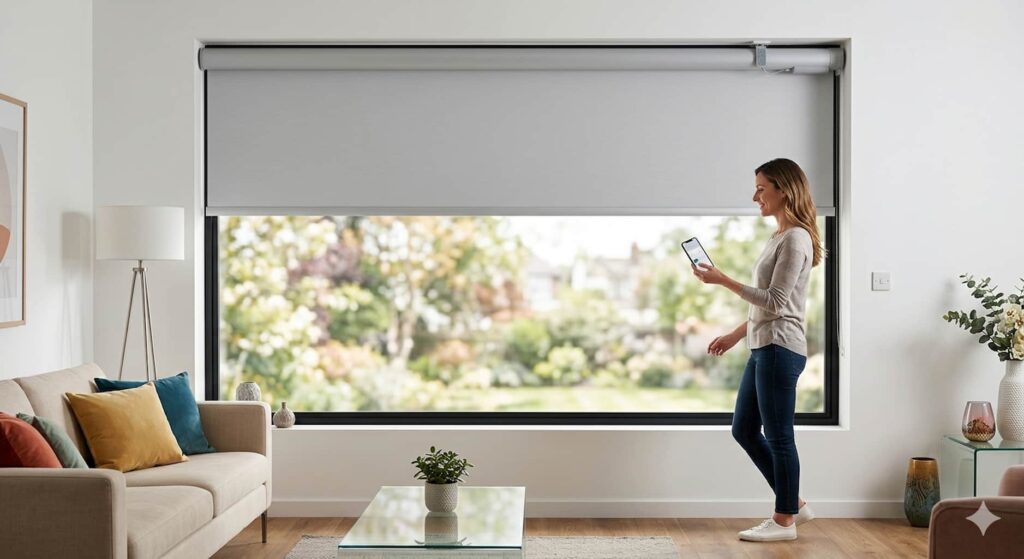
Raising and lowering blinds by hand every day sounds like a minor chore, but anyone with a home full of windows knows it quickly becomes a tiresome routine. On the Costa del Sol, where the sun beats down for much of the year and shielding the inside of the house makes the difference between a pleasant temperature and a domestic oven, automating this everyday gesture is more than just convenience: it’s energy efficiency, real comfort, and a natural first step towards the smart home.
In this article we explain, from the experience of a team specialised in technological solutions for homes and villas in Marbella, how motorised and smart blinds work, what options exist to automate them, and what to consider before making the decision.
Motorised blinds: what they are and how they work
A motorised blind is, in essence, a conventional blind whose manual mechanism (cords, straps, crank) has been replaced with an electric motor that raises and lowers the slats automatically. That motor can be controlled in several ways: through a wall switch, a remote control, a mobile app, or, at the next level, integrated into a smart home system that allows you to programme schedules, scenes and automatic rules.
When a motorised blind connects to the home network and is controlled remotely with intelligent automations, we’re already talking about smart blinds. The difference, therefore, isn’t only in the motor: it’s in the system that governs it and its ability to integrate with the rest of your home.
Types of motors for blinds
Before considering how to automate, it’s worth knowing the motorisation options available. The choice depends on the type of blind, whether it’s new construction or a renovation, and the level of home automation you want to achieve.
Tubular motor
The most widespread option. It’s installed inside the shaft of the roller blind, hidden from view. It provides a clean, silent solution compatible with the vast majority of standard blind boxes. Models are available with radio frequency (RF), Wi-Fi, Zigbee or wired connectivity, depending on the home automation protocol.
External motor
Used when the blind box is small or doesn’t allow internal installation. It’s anchored on the outside and connects to the blind through a secondary shaft. It’s the usual option in renovations where space limits the tubular solution.
Motor for external louvre or venetian blinds
External and venetian blinds require specific motors designed to withstand weather conditions and the particular geometry of each model. In coastal areas, it’s advisable to choose motors with reinforced protection against salinity and humidity.
Motor for curtains and roller shades
Although we’re talking about blinds, the same automation systems apply to motorised curtains and roller shades. Integrating them into a smart home project allows you to manage all types of solar protection from a single interface.
How to automate blinds step by step
Automating the blinds of a home isn’t summed up by “installing a motor”. The complete process, when done professionally, follows a clear sequence:
- Initial audit. Review of the condition of existing blinds, the type of housing, nearby electrical wiring, and the real needs of each room. Not every window requires the same level of automation.
- Selection of the right motor. Tubular, external, for external louvre or for roller shade, depending on the case. The manufacturer and communication protocol are chosen (Somfy, Cherubini, Nice, Vimar and other professional brands are sector benchmarks).
- Control system design. Centralised via a smart home hub (Loxone, KNX, Control4, Vimar, Fibaro) or decentralised with independent Wi-Fi modules. The difference between one and the other affects scalability and long-term reliability.
- Supplementary electrical installation. Adding new power points, dedicated protection panels or conduits if the existing installation isn’t prepared. Many DIY installations underestimate this step and later run into problems.
- Motor and mechanism assembly. Physical installation of the motor in each blind, adjustment of limit switches so it stops exactly where it should, and connection to the control system.
- Programming scenes and rules. This is where the real value of the smart system lies: lowering all south-facing blinds at 2pm when the sun hits, raising them at dawn in bedrooms, closing them all with a single button when leaving home.
- Integration with voice assistants and mobile app. Compatibility with Alexa, Google Home, Apple HomeKit. User access and permission configuration.
- Testing and user training. Testing of all automations, communication verification, manual handover and training so the client can operate the system independently.
Each step requires technical judgement. Skipping or simplifying any of them is usually why many automation projects end up working “halfway” and relying continuously on the installer’s support.
Comparative table: systems to automate blinds
Not all control systems are equal. This table compares the three most common options based on project type:
| System | How it works | Advantages | Limitations | Ideal project |
|---|---|---|---|---|
| RF remote or switch | Radio frequency communication with the motor | Simple, no app or internet required, reliable | No advanced programming or remote control | Punctual renovations, small homes |
| Decentralised Wi-Fi | Each motor or module connects directly to the router | No central hub, easy installation, mobile app | Depends on Wi-Fi network; less reliable with many devices | Flats, homes with few windows |
| Professional smart home hub | Centralised system (KNX, Loxone, Control4, Vimar) | Maximum reliability, scalability, total integration | Higher initial investment, requires technical project | Villas, large homes, new builds |
For a villa or home with many windows, complex automations and integration with climate, lighting, audio and security, the professional hub is the option that ages best. For a second residence or a flat, a well-designed Wi-Fi solution can be perfectly sufficient.
Real benefits of smart blinds
Beyond convenience, automating blinds has measurable impact on several aspects of daily life:
Energy efficiency
A blind that lowers automatically during peak solar radiation hours significantly reduces interior temperature and, therefore, the load on air conditioning. In Mediterranean homes, this automation can result in energy savings of 15-25% on climate control during warm months. In winter, lowering the blinds at dusk reduces thermal losses and lowers the heating bill.
Comfort and automated routine
Waking up to blinds that rise gradually at dawn, without a strident alarm. Coming home to an already-adjusted temperature because the blinds have managed the sun throughout the day. Watching how, when pressing “goodnight” from the phone, the whole house prepares for rest. These small details transform the daily experience of inhabiting the home.
Security and presence simulation
When travelling or spending time away, programming variable openings and closings simulates that the house is inhabited, which is one of the most effective deterrents against burglary attempts. Combined with smart lighting, it reinforces the sense of active presence.
Protection of interior furnishings
Intense sun degrades wooden floors, rugs, paintings, furniture and upholstery. Automation that closes the blinds during maximum exposure periods extends the useful life of interior finishes and keeps original colours intact for years.
Greater durability of the mechanism itself
The smooth, controlled movements of a quality motor reduce wear on slats, pulleys and guides. A well-installed motorised blind can last decades, compared to the typical jams and breakages of intensively used manual systems.
Accessibility
For people with reduced mobility, the elderly or any home with difficult access to certain windows, automation represents a qualitative leap in autonomy and quality of life.
Most useful scenes and automations
When a client asks which automations we recommend, these are the ones that get the most use day to day:
- Gentle sunrise: blinds that rise gradually starting 15 minutes before wake-up time.
- Smart solar protection: automatic lowering when a sensor detects high radiation on a specific facade.
- Cinema mode: closed blinds and dimmed lights when pressing a button in the living room.
- Goodbye and welcome: when leaving home, everything closes; when returning, blinds rise in inhabited areas.
- Holiday mode: random openings and closings that simulate presence.
- Goodnight: complete closure, alarm activated and lights off with a single gesture.
- Wind mode: automatic closure if a weather station detects dangerous gusts, especially useful in coastal areas.
- Climate integration: coordination with air conditioning and heating to optimise comfort and energy expenditure.
These automations are what differentiate a home with motors on the blinds from a truly intelligent home. The technology is the foundation, but the value lies in how it’s programmed.
Integration with the rest of the house: complete home automation
Automating blinds as an isolated element is useful, but the real qualitative leap comes when they’re integrated into a smart home system that controls lighting, climate, audio, security, irrigation and access. In home automation Marbella projects that reach our team, blinds are usually the natural starting point: a client begins wanting to motorise them and, on seeing the possibilities, expands the project to the rest of the home.
This integration allows, for example, for the blinds to lower automatically when the sun hits the south facade hard, the filter curtains to adjust, the air conditioning to reduce its power because the temperature isn’t rising, and the interior lighting to compensate for the loss of natural light if someone is at home. All of this, without the user having to press a single button.
The same approach is valid for projects in Málaga capital and other areas of the Costa del Sol, where the combination of hours of sunshine, high summer temperatures and Mediterranean architecture makes this type of solution especially profitable. In home automation Málaga projects we apply the same technical principles adapted to each type of home and need.
Real cost: what to expect from a professional investment
The price of automating blinds varies considerably depending on the type of motor, the number of windows and the level of integration. As a general reference:
- Basic motorisation per blind (motor + remote or switch): between €150 and €350 per window.
- Wi-Fi motorisation controllable via app: between €250 and €500 per window.
- Professional centralised system (KNX, Loxone, Control4): between €400 and €800 per window, plus the cost of the hub and the programming of the complete system.
- Integral smart home project (blinds + climate + lighting + security): starting from €8,000-15,000 for a medium-sized home, and considerably more in large villas.
Beyond the absolute figures, it’s worth assessing the cost-benefit: energy savings, mechanism durability, daily comfort and property revaluation amply compensate the initial investment in most cases.
Common mistakes when motorising blinds
Five patterns we see repeatedly in projects that come to us for audit or correction:
- Choosing a cheap motor without considering real usage. An economical motor will fail soon on a large or heavily used blind; saving on the motor costs more in the medium term.
- Mixing brands and protocols without criteria. Combining Wi-Fi, Zigbee, RF and Bluetooth without a hub that unifies them turns the house into a puzzle of independent apps.
- Not anticipating the electrical wiring needed. In renovations, discovering that there’s no power near the blind housing involves unbudgeted additional works.
- Ignoring Wi-Fi signal quality throughout the house. Automations depend on stable connectivity; a weak home network generates constant failures.
- Not training the user. Complex systems without training end up underused; the investment only pays off if those living in the home know how to use what they have.
Conclusion: automating blinds is the natural gateway to the smart home
Motorised and smart blinds are one of the most profitable and rewarding investments in any connected home project. They provide immediate convenience, measurable energy savings, reinforced security and a level of comfort difficult to imagine until experienced daily. And, above all, they’re usually the starting point from which many clients begin to explore the real potential of home automation in their properties.
The key, as in any technical project, lies in planning well from the start: choosing suitable motors, a scalable control system, coherent integration with the rest of the house, and a professional installer who guarantees long-term reliability. Done that way, automating your blinds is something you notice every morning and appreciate every summer.
Frequently asked questions about motorised and smart blinds
Can I motorise my existing blinds or do I need to replace them?
In most cases there’s no need to change the complete blind: it’s enough to replace the manual operating system with a compatible motor. If the blind is in good condition and the housing has enough space, motorisation is done without major works. Only in very old or deteriorated blinds is it worth taking the opportunity to renew them completely.
Do motorised blinds work if the power goes out?
By default no, they depend on the home’s electrical current. However, all professional motors have a manual emergency mechanism (a hidden crank) to raise or lower the blind in case of a power cut. In premium projects, backup power can be added through an UPS or connection to self-consumption systems with batteries.
Do blind motors make a lot of noise?
Current mid-to-high range motors operate at very low noise levels, below 45 dB, which is perceived as a soft hum. Premium models are practically silent and especially appreciated in bedrooms, where morning opening shouldn’t disturb sleep. Economical motors can be disturbing at night.
Is it complicated to maintain a smart blinds system?
No, maintenance is very low. Professional motors have a useful life of 10-15 years without intervention. The control system and applications update automatically. The only recommendation is a preventive technical review every 2-3 years to check limit switches, schedule settings and compatibility with firmware updates.
